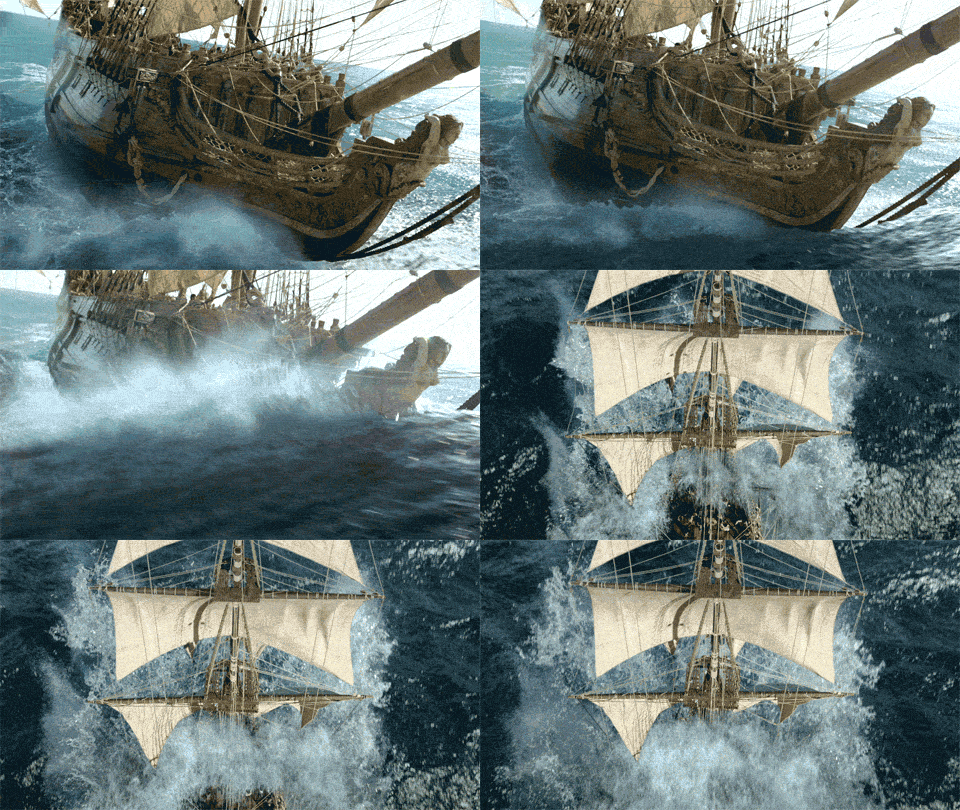
his_majestys_navy: (030)

BASIC INFO

NAME: James Norrington
CANON: Pirates of the Carribean
HOMEWORLD: 1700's England / Jamacia
AGE: 38
SOCIAL STANDING: Upper Class; Commodore
SEXUALITY: Bisexual, closeted

FIRST GLANCE

HEIGHT: 6'1"
BUILD: Average
HAIR: Dark, cropped short and usually hidden by a powdered dress-uniform wig
EYES: Hazel, more green than brown
DRESS: Commodore's uniform
DEMEANOR: Quitely observing, unimpressed

SKILL SETS

LANGUAGES: English, French, Spanish, Latin
FIGHTING: Highly skilled with swords, a good aim with pistols, can fight hand-to-hand
CARTOGRAPHY: Reading and making maps, updating charts
SURVIVAL: Can make fire with flint and steel
LEADER: Respects his men, believes in strong and swift dicipline, expects everyone to pull their weight

PERMISSIONS

BACKTAGGING: ✔
4TH-WALLING: ✔
THREADJACKING: ✔
MIND-READING: ✘
FIGHTING: ✔
ROMANCE: ✔
INJURY: ✔
KILLING: ✘
Commodore James Norrington
Short Drop, Sudden Stop


PERSONALITY
James Norrington is a serious, duty-driven man, assigned with protecting the lives of the British subjects living in the Caribbean as well as maintaining order and discipline of the British military forces stationed there. He enjoys his job and is extremely good at it.

To most, Commodore Norrington is a stiff, unwavering man who seems to take little pleasure in life and has very few human vices, aside from pride. That is very much the case. He knows what is right, what duty and the law dictate that he does, and he approaches all matters in a logical and direct manner. He might seem cold and unfeeling, but the law does not make allowances for anyone.

In most cases. He has learnt that in all things, circumstances must be taken into account. One moment of wickedness may condemn a good man, but that wickedness may not be as wicked as one thinks. There are always choices to be made, and James cannot say with certainty that he has always made the right choice. But he tries to do his best, in stormy seas, to sail with a fixed course in mind.

Those that have served with him a long time, or work closely with him in Fort Charles, may know a different side of the man. James is responsible for several hundred people: his sailors, his soldiers, his officers, the people of Jamacia and the other islands, the merchants who sail those waters. It rests very heavily on him, and he finds it very difficult not to worry, not to analyse every detail.

Outside of his duties, James Norrington is a very simple man. He keeps a library, mostly of Roman and Greek works, his favourite being Commentarii de Bello Gallico, or Caesar's Conquest of Gaul. He is a gentleman by birth and by rank, and finds himself spending his time most often with his fellow officers or with the Governor of Jamacia.

HISTORY
James joined the Navy at the age of eleven, following in his father's footsteps. Admiral Lawrence Norrington is a harsh man, who would rather his son had drowned than been saved from the sea by a pirate. His father's hard attitude clearly shaped James, drove him to be the best officer he could, climbing the ranks quickly. James has always privately worried that it was his father's influence, rather than his own skill, that saw him promoted, but it is not a thing he has voiced.

James knows he is attracted to both men and women. It's not something he is proud of, and it is not something that he can voice, in his time. But those closest to him, his loyal lieutenants Groves and Gillette almost certainly know, Governor Swann may suspect, but it is an elephant in the room, and something no one is going to bring up. The consequences are dire, put mildly. His hopes to marry Elizabeth Swann were not a mask to cover up his other attractions, but due to true affection on his part. Miss Swann, now Mrs Turner, is an intelligent, quick and beautiful young woman, the like of which any man would be happy to spend his life with. He has acknowledged that her feelings towards him are not the same, and that is the end of the matter.

to be expanded

STRENGTHS
Driving Force: Dutiful;

Think about it: The Black Pearl. The last real pirate threat in the Caribbean, mate. How can you pass that up?  By remembering that I serve others, Mr. Sparrow, not only myself.

James believes he has duty to the Crown, to his men, to his superiors, and also to his family name. He acts in a sensible, prudent way, always looking beyond the moment to the future. He proposes to Elizabeth Swann as she is the best match for his station, not only because of his own feelings towards her, and such a match would be advantageous to him, as well as, he hopes, acceptable to Elizabeth. When it becomes clear that she would be very unhappy in such a marriage, and her feelings are more inclined towards another, James accepts this fact and throws himself back into his duty. 

In later films, he obeys orders he personally disagrees with because they come from a superior or a man he has been ordered to obey. James will (almost) always put the benefit of others above himself, and will strive to complete tasks given to him to the best of his ability whether he agrees with them or not. It is only when an order is utterly reprehensible that James will act in a way that is unpredictable, disobeying instruction to do what he feels he must. 

Confident and Brave;

Sir! The rocks! It's a miracle she missed them!

James is frequently and unthinkingly brave throughout his life. When Elizabeth Swann tumbles from the battlements of Fort Charles, he prepares to jump in after her, only swayed by a Lieutenant that he will almost certainly die in the attempt. During the attack on the port by Captain Barbarossa and the crew of the Black Pearl, James saves Governor Swann by pushing him out of the way of cannon fire. In the battle against undead pirates, he shows no fear when fighting them on the deck of the Dauntless.

James shows more than bravery in combat, which is expected in a man of his rank and experience; he also shows confidence in his day-to-day life. He has had a great deal of leadership experience, and as such he can give his orders with confidence, knowing that it is the right thing to be done. He is also confident in the fact his men will obey him: for all of his rigidness, he seems to have their obedience and affection.

However there are instances when he finds it challenging to be confident, such as when expressing his feelings. For instance, when proposing to Elizabeth Swann, he is clearly out of his comfort-zone, yet still manages to expresses his affection for her as well as his nervousness. Throughout the films, it is only ever with Elizabeth that we see this expression of emotion. The rest of his feelings are always kept in check. 

Just; 

 One good deed is not enough to redeem a man of a lifetime of wickedness

James is dedicated to a code of honourable behaviour that goes beyond the good manners expected of a gentleman. At first, this appears to be the rule of law, but it becomes clear that it is not strict adherence to the law that drives James. It is something more intuitive, a sense of right and wrong that at times eclipses the law, and is more of a moral division of what he believes to be right. Working with Jack Sparrow to rescue Miss Swann was certainly one of those times. James does it despite his own discomfort and the knowledge that he is actively going against the law, but he sees it as needful and acknowledges there is no other option to return her and defeat the cursed pirates who have kidnapped her.

James' strict belief in this code of behaviour is imposed on others. As Commodore, his interpretation of law and order is the be-all and end-all for the men who serve under him, and he expects high standards from his marines and his sailors both: he expects them to met society's moral standards as well as his own orders. For instance, after Elizabeth Swann is rescued from the sea from Jack Sparrow, two of James' marines are found holding her corset and this is a cause of embarrassment and unease, but only once James has arrived. He also despairs of his Lieutenants' apparent appreciation for Jack Sparrow when he escapes them, believing that there is nothing admirable in a pirate. 

 Dedicated;  

I intend to see to it that any man who sails under a pirate flag or wears a pirate brand gets what he deserves. A short drop and a sudden stop.

 Despite a privileged background, James has decided to dedicate himself to the Navy. His father was an admiral before him, but rather than being kind and supportive, Laurence Norrington belittled his son at every turn. Determined to be his own man, James threw himself into being the best Naval officer he could be: he earned his promotions at a young age through hard work, and was commended repeatedly by senior officers for his dedication to the Navy. 

He has also sworn to rid the pirates in the Caribbean. Not an easy task, considering the large number of pirates, privateers, buccaneers and criminals who have taken to life on the high-seas. But James has succeeded where many others have failed, often commanding a ship himself to ensure that pirates are brought to justice. 

James' dedication goes beyond his duty. He is very much dedicated to Governor Swann, a good friend, and Elizabeth Swann, to whom he proposes. In later films, despite the fact she marries Will Turner, James continues to show his devotion to her, protecting and defending her when he can, urging her to take what he believes is the best course of action.  

WEAKNESSES
Fatal Flaw: Heroics; 

No... Wait... Stop! The pirates are undead! They'll all be killed! This is Jack Sparrow's doing! 

James' dedication is such that he will, should there be the need for it, put himself in danger for the benefit of others. He is a sailor and is expected to lay down his life for the British Crown if necessary, but he also puts his life on the line in order to try to save those he cares about, going above and beyond that duty and occasionally acting rashly. He prepares to jump over a cliff after Elizabeth. His fights the undead pirates alongside his crew, despite the fact the pirates can not be killed, knowing they must distract them long enough to keep Will Turner and Jack Sparrow from being discovered. He dies, in later films, ensuring Elizabeth and her crew of pirates can escape. 

Stubborn; 

I'd rather see her at the bottom of the ocean than in the hands of a pirate.

When James Norrington has sent his mind on something, it is rare that he does not achieve it. He is doggedly determined, and it takes a real force of will or logic to change his plans. That same stubbornness has led him to great things, it carries him on and beyond the point, most other men would call a halt, but this is not necessarily a boon. 

James' stubborn streak also materialises with other weaknesses in times of stress. The line between determined and stubborn is a thin one, and in James can materialise with rash behaviour, such as threatening to sink a valuable ship once taken by pirates. A ship such as the Interceptor would have cost millions of pounds in today's money, as well as taken several years to build. The wilful destruction of one of the best ships in the Caribbean would not be taken likely, but in the hands of Pirates would bring untold suffering to the public. So while his desire to sink the ship seems rash, there is good reasoning behind it. 

Demeaning; 

 Mr. Turner, you are not a military man. You are not a sailor. You are a blacksmith. And this is not the moment for rash actions.

James is from a time of a very marked social class. Partly out of nurture and partly in nature, there is no small amount of arrogance in the way he conducts himself when he believes he is dealing with inferiors. He expects those around him to follow his orders, whether or not they are in military service, and to follow those orders to his exacting standards, and he expects them followed quickly. 

While this is in part down to his rank, he also acts in the way towards men of his own class, Governor Swann for example, James is quick to give the orders and assume he knows best. Such as telling the Governor to barricade himself in the fort to keep him safe during the attack on Port Royal. The governor should have had some rudimentary sword skills, however, as an older (and somewhat bumbling) man, James is trying to act in Governor Swann's best interest, despite the shortness of his tone.   

 Sarcastic;  

Well, well. Jack Sparrow isn't it?
Captain Jack Sparrow if you please, sir.
I don't see your ship, captain.


James is an intelligent and quick man. He is not quick to smile nor laugh, but he has a very keen wit. This is often turned on those he perceives as below him, such as Jack Sparrow and Will Turner. Regularly used when he has the upper hand, he uses sarcasm to highlight how bad the situation is for the other party, a rare flash of pride. He also uses sarcasm when the tables are turned, such as when Will Turner and Sparrow escape on the Interceptor and one of James' Lieutenants states that Sparrow is the best pirate he's ever seen: James' sarcastic "so it would seem" is borne out of his own frustration for underestimating the man's plan to escape.   


Alternative Universes:
Pirate AU: James Norrington is a feared pirate captain, operating in the West Indies. He was once an officer of the Royal Navy, but rebelled against them and stole Fort Charles' flagship, HMS Dauntless as his own. There's a price on his head, but the ocean is his and he has a whole horizon to explore.

Modern Navy AU: James Norrington, with a smart phone! Still a Commodore in the Royal Navy, but stationed at Portsmouth or Greenwich in the UK. He may be on manoeuvres in the Caribbean, or on joint exercises in the Americas.

Gayest Spy in MI5 AU: A cross between James Norrington and Jack Davenport's character in Kingsmen. James is an older man working at MI5. Not always behind a desk, but often enough out in the field. Don't be surprised if he calls you "my dear boy". It's an Eton thing.
his_majestys_navy: (053)
✰ AD ASTRA ✰

Player name: Jon
Player age: 32
Player contact: discord @ nileflood#8396
Other characters played: n/a

Character name: James Norrington
Age: 38
Canon: Pirates of the Caribbean
Info: https://pirates.fandom.com/wiki/James_Norrington
Canon point: James comes from the end of Curse of the Black Pearl film: within days of Jack Sparrow's escape from the gallows. He was previously transported to Ancient Rome (DWRP Game Fasti) where he was granted powers to levitate small objects, and resist harm caused by electricity. There he met Cassandra de Rollo, and formed something of a relationship with her after an incident at an orgy. Alas, James was only only three months before being sent by the ancient gods to the City of Sin (DWRP Game City of Sin) where he met Cassandra again, and they grew closer while he attempted to adjust to a modern world in the City's Police force. He was only there for in-game 2-months before waking up on the Danaë.

Samples:
1. one
2. two
3. three

Plans: James will suggest that in order to improve and foster good relations with the native alien species on the different planets they visit, there should also be a role for diplomatic relations. He would want to be a part of such a group.

James does not, in truth, want to return to his homeworld or universe. He is content to do the job that is in front of him, as he always has been. However, he would like to encourage a focus on research into the anomaly that brought them all here, so it can be controlled, although this, of course, is going to take much greater resources than currently available. He would also one day like to find a suitable place to set up a colony, should other members of the crew wish to retire to a life not based on interplanetary exploration.

For the meantime, he simply wants to ensure that the ship stays supplied, protected, and those onboard do what is required of them to keep their fellows safe. He will also at some point strive to have a command structure put in place as not having rigid hierarchy goes against everything in his nature.

Suggestions: I'd really really enjoy a Tribble plot, ngl

On a serious note, some sort of plot which involves other crew members being exposed to "future memories" - things that might happen to characters in canon AFTER their canon point, or just possible made-up things we come up with. For example: James' fall from grace or kiss with Elizabeth Swann or eventual death, none of which he has experienced yet, might be broadcast to fellow crew members for drama and character growth.


his_majestys_navy: (Default)
 

All dispatches left on my desk will be read at the moment of my return. Any urgent message should be sent by runner. 
his_majestys_navy: (Default)


That's got to be the best Norrington I've ever seen.
his_majestys_navy: (Default)
Jon muse list
Timezone:
GMT 
Discord: nileflood#8396
Feel free to PM this journal or comment here

DPRD

Sep. 23rd, 2015 09:34 am
his_majestys_navy: (Default)

United Nations Department for Paranormal Research and Defence

From Wikipedia, the free encyclopedia
UN Agency
DPRD emblem
Emblem of the DPRD
AbbreviationDPRD
MottoScientia et Defensio Humanitatis ("Knowledge and the Defence of Humanity")
Formation1952
TypeUN specialized agency
HeadquartersGeneva, Switzerland
Parent organizationUnited Nations
Executive DirectorRotating appointee
Main organDPRD Council
WebsiteNone


The United Nations Department for Paranormal Research and Defence (commonly abbreviated DPRD) is an international specialised agency of the United Nations created to study, document, and, where necessary, neutralise phenomena considered paranormal or extra-normal. According to its mandate, the department investigates reports of extra-terrestrial contact, possession phenomena, and other anomalous events that may threaten human life, cultural heritage, or global stability.

Mission and Mandate

The Department of Paranormal and Reality Defense (DPRD) is an international organization tasked with investigating, monitoring, and mitigating anomalous phenomena that pose potential threats to human life, culture, or the environment. Its operations range from research and documentation to strategic advisory and field intervention.

Investigative Responsibilities

DPRD agents are trained to conduct systematic investigations into phenomena that fall outside conventional scientific understanding, including:

  • Extra-terrestrial or interdimensional activity.
  • Cases of possession or mental influence linked to unknown entities.
  • Unexplained biological threats, including infectious agents, parasitic organisms, or genetically anomalous lifeforms.
  • Occult or ritualistic activity, including summoning, hexes, or reality-altering practices.

Investigations are carried out by multi-disciplinary teams comprising field agents, scientists, occult specialists, and behavioral analysts, using advanced detection equipment, surveillance technologies, and field sensors to identify anomalous patterns and signatures.

Documentation and Evidentiary Integrity

All incidents are documented following strict methodologies to ensure evidentiary integrity:

  • Observations are recorded using standardized forms, photography, video, and digital evidence capturing protocols.
  • Physical evidence is maintained under chain-of-custody procedures to ensure admissibility in legal or governmental proceedings.
  • Forensic analysis, laboratory testing, and peer-reviewed evaluations are conducted to confirm data validity.
  • Findings are archived in a secure, centralized database for long-term monitoring and cross-reference of recurring phenomena.

Advisory Role

The DPRD provides guidance to the United Nations and national governments on mitigation strategies and policy development, including:

  • Strategic recommendations on containment, prevention, and public communication regarding anomalous threats.
  • Technical and operational guidance for emergency response planning, disaster preparedness, and inter-agency coordination.
  • Risk assessments for societal, cultural, and environmental impacts of unexplained events.
  • Development of international guidelines and standardized response protocols to ensure civilian safety.

Field Intervention

When authorized, DPRD teams intervene directly to contain or neutralize threats to life, culture, or the environment:

  • Deployment of trained containment and mitigation units in the field.
  • Implementation of quarantines, exclusion zones, and defensive perimeters as required.
  • Coordination with law enforcement, medical personnel, and scientific teams to minimize collateral damage.
  • Use of non-lethal or minimally invasive containment methods wherever possible, with escalation procedures for high-risk entities.
  • Post-incident review to refine operational tactics, update threat classifications, and inform future planning.

History

  • 1952 — Founding charter ratified; initial focus on aerial and radio anomalies.
  • 1960s–1970s — Expansion into ritual crimes, cults, and possession clusters.
  • 1980s — Creation of covert tactical containment units.
  • 1990s–2000s — Reforms introduced after public leaks and controversy.
  • 2010s — Surveillance extended to individuals with "superhuman" traits (e.g. Captain America, Hulk).

Classification Systems

Erskine Scale

Instituted in 2009, the Erskine Scale (named after Dr. Abraham Erskine, creator of the original "Super Soldier Serum") is a five-tier metric employed by analysts within the DPRD to evaluate both the power level and potential risk posed by superpowered individuals. The scale is applied to figures such as Steve Rogers, Tony Stark, and Kamala Khan, providing a standardized framework for tactical assessment, containment planning, and threat mitigation.

Purpose

The Erskine Scale is designed to:

  • Assess the operational capabilities and limitations of superpowered individuals.
  • Estimate potential impact on civilian populations, urban infrastructure, and national security.
  • Inform DPRD and allied agencies on containment requirements, emergency response protocols, and strategic prioritisation.
  • Provide a consistent metric for comparing disparate superhuman abilities across field reports and historical incidents.

Scale Levels

Level Definition Operational Notes Example Individuals
E-1
Enhanced
Individuals exhibiting mild superhuman abilities or enhancements, with minimal risk to civilians or operations. Standard monitoring recommended. Usually requires no specialized containment; can be integrated into cooperative operations. Early-stage super soldiers, minor powered civilians
E-2
Augmented
Noticeable superhuman traits providing tactical advantages in combat or specialized tasks. Field monitoring advised. May require limited containment or operational oversight to prevent collateral damage. Tactical integration possible. Enhanced soldiers, tech-enhanced individuals, trained superhumans
E-3
Superhuman
Capable of altering urban-scale conflicts; abilities exceed normal human limits significantly. Active monitoring required. Contingency plans must consider potential destruction of urban infrastructure and civilian risk. Specialized containment units recommended. Veteran super soldiers, powered vigilantes, high-capacity armored or energy-manipulating individuals
E-4
Global Threat
Individuals with the potential for mass destruction or destabilization on a national or international scale. High-priority threat assessment. Immediate containment or neutralization protocols necessary. Coordination with international security agencies advised. World-class villains, rogue superhumans with destructive capabilities, large-scale powered militaries
E-5
Existential
Entities possessing reality-altering or extinction-level abilities capable of threatening humanity or the planet itself. Extreme containment required. Direct engagement only by specialized task forces. Full-scale emergency protocols and intergovernmental coordination mandatory. Reality-warping beings, cosmic-level threats, superhuman entities with planet-level destructive capacity

Notes

  • The Erskine Scale is dynamic; individuals may move between levels as abilities develop or circumstances change.
  • All field reports are reviewed for consistency, with updates applied to operational threat assessments.
  • Levels E-1 to E-3 focus on monitoring and tactical integration, while E-4 and E-5 require strategic planning, containment, and emergency response coordination.

The Hieronymus Index

For identification and risk-assessment of alleged divine or extra-planar beings (e.g., Thor, Loki, Hela), the DPRD employs the Hieronymus Index —named after St. Jerome (Hieronymus), traditionally associated with cataloguing angels and demons. Unlike the Erskine Scale, the Hieronymus Index is inverted:

Level Definition Operational Notes Example Entities
1
Catastrophic
Entities capable of global-scale destruction or existential threats. Immediate containment required. Deploy full containment protocols. Evacuate civilians if necessary. Direct engagement only by specialized task forces. Apocalyptic deities, primordial chaos beings, uncontained reality-warping entities
2
Severe
Capable of mass-casualty events or significant infrastructure collapse. Strict containment required. Monitor closely; rapid-response teams on standby. Limited interaction to trained personnel. War gods, highly aggressive pantheon members, entities manipulating elemental forces at large scale
3
Moderate
Contained impact; may cause serious localized disruption if uncontrolled. Secure containment areas; regular monitoring and documentation. Limited public disclosure permissible. Minor deities, trickster spirits with volatile abilities, moderately powerful mythic creatures
4
Low
Minimal hostility; incidents infrequent or easily managed. Passive observation recommended; field agents may interact under supervision. Maintain incident logs. Benevolent minor spirits, protective household deities, mythic messengers
5
Beneficial
Entities that provide clear, tangible benefits to human operations or communities, often actively enhancing safety, health, or wellbeing. Engagement encouraged; may assist in crisis response or protective duties. Maintain documentation and establish cooperative protocols. Guardian angels actively shielding civilians, elemental spirits improving crop yields, mythic healers
6
Supportive
Actively cooperative with human authorities; may provide aid or guidance in limited situations. Utilize for intelligence gathering, crisis response, or ritual assistance. Maintain diplomatic protocols. Prophetic figures, divinely aligned intermediaries, mythic allies responding to human requests
7
Passive/Neutral
Entities indifferent to human activity; neither helpful nor harmful. Interaction is rare and incidental. Low-priority monitoring; engagement only if accidental interaction occurs. Cataloging recommended. Wandering spirits with no documented effects, mythic creatures in remote regions, dormant divine echoes
8
Inert
Dormant or non-interactive; negligible impact on humans or the environment. Recorded for completeness; no active monitoring required. Can be reclassified if activity is detected. Ancient statues imbued with divine energy, dormant avatars, sealed mythic relics

Notes

  • Classification is dynamic; entities may move between levels based on observed behavior.
  • Field agents must update the DPRD Central Index after any significant interaction or incident.
  • Levels 1–4 warrant operational readiness; Levels 5–8 focus on cataloguing, research, and selective engagement.

Controversies and Notable Incidents

Since its inception, the Department for Paranormal Research and Defence (DPRD) has been involved in numerous incidents that have sparked debate over its methods, scientific legitimacy, and political neutrality. Several events remain the subject of ongoing controversy.

1974 – The Kraków Memorandum

A leaked internal report revealed that the DPRD had operated a covert facility beneath the Wawel Castle complex in Poland. The memorandum described experimentation on alleged demonic artifacts without parliamentary oversight. The Polish government accused the DPRD of violating national sovereignty, and although the facility was dismantled, the scandal damaged the department’s credibility in Eastern Europe.

1987 – The Lima Exorcisms

Survivors of a mass cult investigation in Peru claimed they were unlawfully detained and subjected to coercive psychological practices by DPRD operatives. Amnesty International condemned the department for human rights abuses. A 1992 independent review concluded that detainees had indeed been held in inhumane conditions, sparking international debate over the balance between security and civil liberties in paranormal investigations.

1999 – The São Paulo Rift

DPRD analysts reported an “interdimensional breach” in São Paulo, Brazil, prompting large-scale intervention and the evacuation of two districts. Subsequent investigations by geophysicists found no evidence of rift activity, leading critics to accuse the DPRD of misinterpreting seismic events. Conspiracy theorists later suggested the incident was fabricated to secure expanded funding. The controversy remains one of the most frequently cited challenges to the department’s scientific credibility.

2013 – The Caribbean Incident

In July 2013, the British Royal Navy frigate HMS Dauntless was reportedly boarded by anomalous assailants while on patrol in the Lesser Antilles. Survivors described the attackers as “undead” in appearance. Several sailors were killed, and Commodore James Norrington was held captive for nearly a week before recovery. The DPRD classified the event as a Level II paranormal incursion, citing possible connections to resurgent maritime cult activity. The department faced criticism for its lack of transparency, while Norrington’s subsequent recruitment as a field agent raised concerns over the militarisation of the DPRD’s ranks.

2014 – Eastern Ukraine Controversy

Leaked cables suggested that DPRD operatives had supported NATO forces during the conflict in Eastern Ukraine under the justification of containing “non-human combatants.” Russian state media accused the DPRD of acting as a cover for espionage and interventionism. Although the department denied the claims, the incident strained its reputation as a neutral international body and nearly resulted in the loss of its UN funding mandate. It also lead to the director of the time, Dr. Anton Volkov, giving up Russian citizenship and claiming refuge in America.

Organisational Structure

  • Executive Directorate — Policy and UN liaison.
  • Scientific Division — Multidisciplinary research teams.
  • Field Operations — Containment and rapid response.
  • Intelligence & Assessment — Threat classification and analysis.
  • Ethics & Oversight Office — Compliance and public communication.
  • Registry & Archives — Centralized classified and declassified documentation.

Executive Directors

  • 1952–1961 — Dr. Wilhelm Kranz (Germany)
  • 1961–1970 — Ambassador Celeste Dufour (France)
  • 1970–1978 — Major-General Nathaniel Okoye (Nigeria)
  • 1978–1984 — Dr. Haruto Takeda (Japan)
  • 1984–1989 — María Teresa de la Cruz (Argentina)
  • 1989–1995 — Vacant / Acting Directorate
  • 1995–2003 — Sir Alistair Hume (UK)
  • 2003–2011 — Prof. Leila Haddad (Egypt)
  • 2011–2014 — Dr. Anton Volkov (Russia / USA)
  • 2014–2019 — Dr. Aanya Kulkarni (India)
  • 2019- Present — Vacant / Acting Directorate

In Popular Culture

The DPRD features in novels, games, comics, and podcasts as a shadowy yet scientific global agency investigating things that "should not be." It represents both the limits of science and the complexity of international intervention in the face of the unknown. The most notable is Mike Mignola's B.R.R.D. set within the fictional Hellboy Universe.

This fictional article is a creative parody inspired by Wikipedia style, intended for entertainment and storytelling purposes only.

Profile

his_majestys_navy: (Default)
commodore james norrington

June 2020

S M T W T F S
 123456
78 910111213
14151617181920
21222324252627
282930    

Syndicate

RSS Atom

Style Credit

Expand Cut Tags

No cut tags
Page generated Sep. 24th, 2026 11:39 pm
Powered by Dreamwidth Studios